
This page explains how booking and visitor data are owned, shared, retained, and anonymised when you use resource and reception sharing. It focuses on privacy and data ownership only:
Resource sharing and booking data
Resource sharing overview
Resource sharing lets an organisation share locations and resources, like desks or rooms, with other organisations.
For example, Organisation 1 shares a resource (Room A) with Organisation 2. Both organisations are in the same building, but occupy different floors. Users from Organisation 2 can book these shared resources as if they were part of their own organisation.
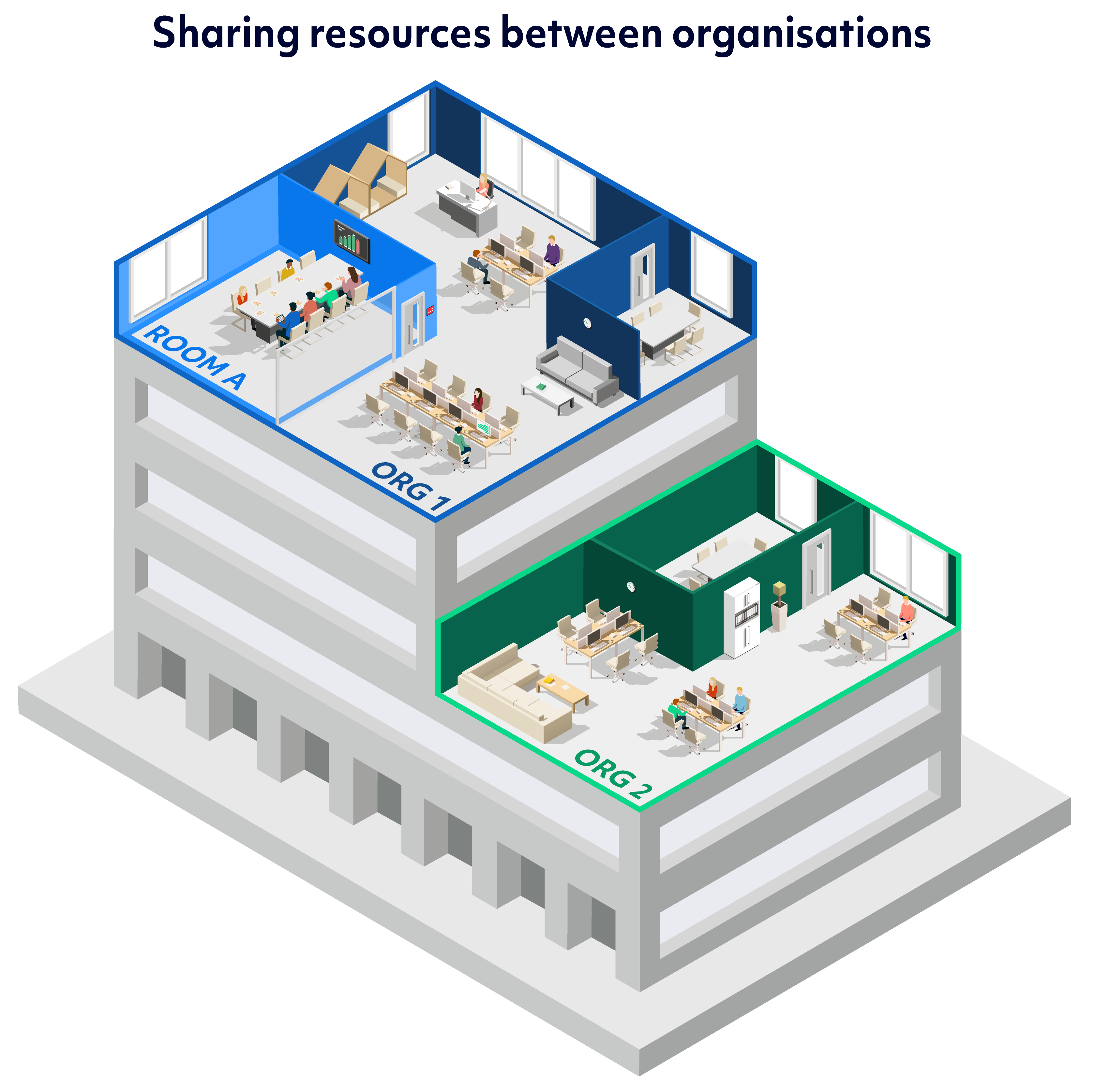
Organisation 1 is the sharer organisation; Organisation 2 is sharee organisation.
Although the example above shows 1 shared resource in 1 shared building, this setup could be applied to multiple shared resources and across multiple buildings.
Sharing a high-level location, like a floor, includes all the resources within it. This is useful for shared offices where multiple organisations use the same workplace. Private resources stay hidden unless you explicitly share them.
Learn more about resource sharing
Booking data anonymisation
The resource-owning organisation determines if and when resource bookings are anonymised, regardless of which organisation made the booking (the number of days after which booking data is anonymised). The booking data that’s anonymised is the owner, attendees, title, notes, and request notes (for example, layouts). Settings are inherited from the highest levels of the location and resources hierarchy to the lowest. Once anonymised, the data can’t be recovered.
Booking data visibility
Generally, users from one organisation can see the details of bookings made by other users of their organisation. If this isn’t wanted, the booking data visibility setting can be changed so that the details are only visible to the person who made the booking, the owner (if different), attendees, or location managers and above.
With regards to resource sharing, users from one organisation can’t see the booking data of users from another organisation. The exception is for location managers or above of the shared resources.
Reception sharing and visitor data
Note: for reception sharing, the roles of sharer and sharee organisations are reversed. The sharee organisation shares their reception with the sharer.
This section includes:
Reception sharing overview
Reception sharing allows an organisation to share its reception with another organisation. This typically happens when 2 or more organisations occupy the same building. The sharee organisation’s receptionists can manage visits for the sharer organisation. They can:
-
view visitors
-
check in and check out visitors
-
update visit details
The sharee organisation maps its real reception to the sharer organisation’s reception. The Welcome app supports this shared-reception model.
Visitor anonymisation
This permanently anonymises a visitor’s data, but their record remains in the external directory. If the directory contains a person’s details and they aren’t associated with a visit or booking, the system will permanently remove them from the directory instead.
Where reception sharing is active, anonymisation follows the rules of the host organisation being visited. For example, if that organisation has anonymisation set to 5 days, the visitor’s details will be anonymised after 5 days, and therefore the sharee organisation won’t see the visitor’s details either.
The sharee organisation doesn’t influence when the sharer visitor data is anonymised.
Learn more about GDPR, data retention, privacy, limiting visibility and access